Publications

You can also find some of my articles on my Google Scholar profile.

Click the following links to jump to the relevant category:
Monographs & collected volumes | Peer-reviewed articles and chapters | Reviews | Theses | Other publications

Monographs & collected volumes


Peer-reviewed articles and chapters


La linguistique historique: une ancienne discipline et ses défis modernes

Mémoire des savoirs. Cent ans d'Études de Lettres (1926–2026), 2026

Cite as: Robin Meyer. 2026. La linguistique historique: une ancienne discipline et ses défis modernes. In Marc Escola, Constance Frei, Martine Hennard Dutheil de la Rochère (eds.), Mémoire des savoirs. Cent ans d'Études de Lettres (1926–2026), 275-282. Université de Lausanne.
Download

etymologischer Akzent

Wörterbücher zur Sprach- und Kommunikationswissenschaft (WSK) Online, 2025

Cite as: Robin Meyer. 2025. etymologischer Akzent. In Stefan J. Schierholz, Laura Giacomini (eds.), Wörterbücher zur Sprach- und Kommunikationswissenschaft (WSK) Online. De Gruyter.
Download

Wortakzent

Wörterbücher zur Sprach- und Kommunikationswissenschaft (WSK) Online, 2025

Cite as: Robin Meyer. 2025. Wortakzent. In Stefan J. Schierholz, Laura Giacomini (eds.), Wörterbücher zur Sprach- und Kommunikationswissenschaft (WSK) Online. De Gruyter.
Download

Akzent

Wörterbücher zur Sprach- und Kommunikationswissenschaft (WSK) Online, 2025

Cite as: Robin Meyer. 2025. Akzent. In Stefan J. Schierholz, Laura Giacomini (eds.), Wörterbücher zur Sprach- und Kommunikationswissenschaft (WSK) Online. De Gruyter.
Download

Origin and aspect of the converb in Classical Armenian

Diachronic, Typological, and Areal Aspects of Converbs, 2024

Cite as: Robin Meyer. 2024. Origin and aspect of the converb in Classical Armenian. In Paola Cotticelli-Kurras, Eystein Dahl, Jelena Živojinović (eds.), Diachronic, Typological, and Areal Aspects of Converbs, 71–90. De Gruyter Mouton.
Download

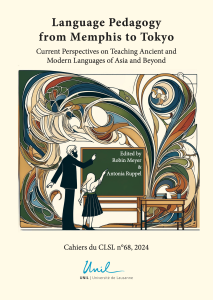
Teaching the Language of Asia. An Introduction

Language Pedagogy from Memphis to Tokyo: Current Perspectives on Teaching Ancient and Modern Languages of Asia and Beyond, 2024

Cite as: Robin Meyer, Antonia Ruppel. 2024. Teaching the Language of Asia. An Introduction. In Robin Meyer, Antonia Ruppel (eds.), Language Pedagogy from Memphis to Tokyo: Current Perspectives on Teaching Ancient and Modern Languages of Asia and Beyond, 7–15. Université de Lausanne.
Download

Contextualising Ancient Language Teaching. The Case of Classical Armenian

Language Pedagogy from Memphis to Tokyo. Current Perspectives on Teaching Ancient and Modern Languages of Asia and Beyond, 2024

Cite as: Robin Meyer. 2024. Contextualising Ancient Language Teaching. The Case of Classical Armenian. In Robin Meyer, Antonia Ruppel (eds.), Language Pedagogy from Memphis to Tokyo. Current Perspectives on Teaching Ancient and Modern Languages of Asia and Beyond, 91–113. Université de Lausanne.
Download

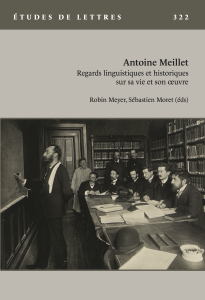
Antoine Meillet, parrain de la linguistique arménienne

Antoine Meillet. Regards linguistiques et historiques sur sa vie et son œuvre, 2023

Cite as: Robin Meyer. 2023. Antoine Meillet, parrain de la linguistique arménienne. In Robin Meyer, Sébastien Moret (eds.), Antoine Meillet. Regards linguistiques et historiques sur sa vie et son œuvre, 73–96. Université de Lausanne.
Download

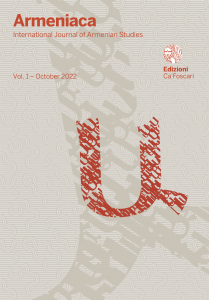
Armenia(n) through the Ages

Armeniaca. International Journal of Armenian Studies, 2022

Cite as: Robin Meyer, Irene Tinti. 2022. Armenia(n) through the Ages. Armeniaca. International Journal of Armenian Studies 1: 7–13
Download

Armenian Morphosyntactic Alignment in Diachrony

Alignment and Alignment Change in the Indo-European family, 2022

Cite as: Robin Meyer. 2022. Armenian Morphosyntactic Alignment in Diachrony. In Eystein Dahl (eds.), Alignment and Alignment Change in the Indo-European family. Oxford University Press.
Download

Alignment change and changing alignments: Armenian syntax and the first ‘death’ of Parthian

Ancient Indo-European Languages between Linguistics and Philology: Contact, Variation, and Reconstruction, 2022

Cite as: Robin Meyer. 2022. Alignment change and changing alignments: Armenian syntax and the first ‘death’ of Parthian. In Michele Bianconi, Marta Capano, Domenica Romagno, Francesco Rovai (eds.), Ancient Indo-European Languages between Linguistics and Philology: Contact, Variation, and Reconstruction, 211–233. Brill.
Download

Multilingualism in Poetry: How to Translate Sayat`-Nova

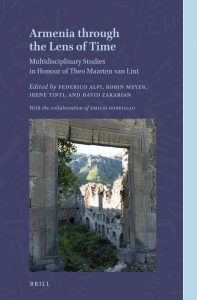
Armenia through the Lens of Time. Multidisciplinary Studies in Honour of Theo Maarten van Lint, 2022

Cite as: Robin Meyer. 2022. Multilingualism in Poetry: How to Translate Sayat`-Nova. In Federico Alpi, Robin Meyer, Irene Tinti, David Zakarian (eds.), Armenia through the Lens of Time. Multidisciplinary Studies in Honour of Theo Maarten van Lint. Brill.
Download

Armenia through the Lens of Time: A 360° View

Armenia through the Lens of Time. Multidisciplinary Studies in Honour of Theo Maarten van Lint, 2022

Cite as: Federico Alpi, Robin Meyer, Irene Tinti, David Zakarian. 2022. Armenia through the Lens of Time: A 360° View. In Federico Alpi, Robin Meyer, Irene Tinti, David Zakarian (eds.), Armenia through the Lens of Time. Multidisciplinary Studies in Honour of Theo Maarten van Lint. Brill.
Download

Syntactical Peculiarities of Relative Clauses in the Armenian New Testament

Revue des Études Arméniennes, 2018

This paper endeavours to show that, at least as far as the syntax of relative clauses is concerned, the form of the Armenian language employed in the Bible translation does not fully correspond to that found in non-translated Armenian literature. It will be shown that, as argued by Lafontaine and Coulie (1983), next to Classical and Hellenising Armenian, we must construe a pre-Hellenising layer of the language. This layer, it is argued, is not to be separated from the Yunaban Dproc‘; instead, both form part of a continuum of Greek influence on Armenian. This is evident in the applicability of different case matching restrictions in Biblical texts compared to the works of Agat‘angełos, Eznik, and Ełišē, specifically in free and light-headed relative clauses. The case of the relative pronoun in Greek relative clauses can be determined by the matrix clause in Biblical Armenian, whereas in non-translated literature such structures do generally not occur. It will further be argued that cases of Armenian ‘relative attraction’ present almost exclusively in free relative clauses; taking as its basis patterns put forward by Grosu (1994) and Keenan and Comrie (1977), these cases of attraction, together with evidence from Greek, will be taken as indication for the existence of what may be called Discourse Accessibility Hierarchy.

Cite as: Robin Meyer. 2018. Syntactical Peculiarities of Relative Clauses in the Armenian New Testament. Revue des Études Arméniennes 38: 35–83
Download

Morphosyntactic Alignment and the Classical Armenian Periphrastic Perfect

Proceedings of the 26th Annual UCLA Indo-European Conference : Los Angeles, October 24th and 25th, 2014, 2016

Cite as: Robin Meyer. 2016. Morphosyntactic Alignment and the Classical Armenian Periphrastic Perfect. In Stephanie W. Jamison, Craig H. Melchert, Brent Vine (eds.), Proceedings of the 26th Annual UCLA Indo-European Conference : Los Angeles, October 24th and 25th, 2014, 117–133. Hempen.
Download

Reviews


Theses


Other publications